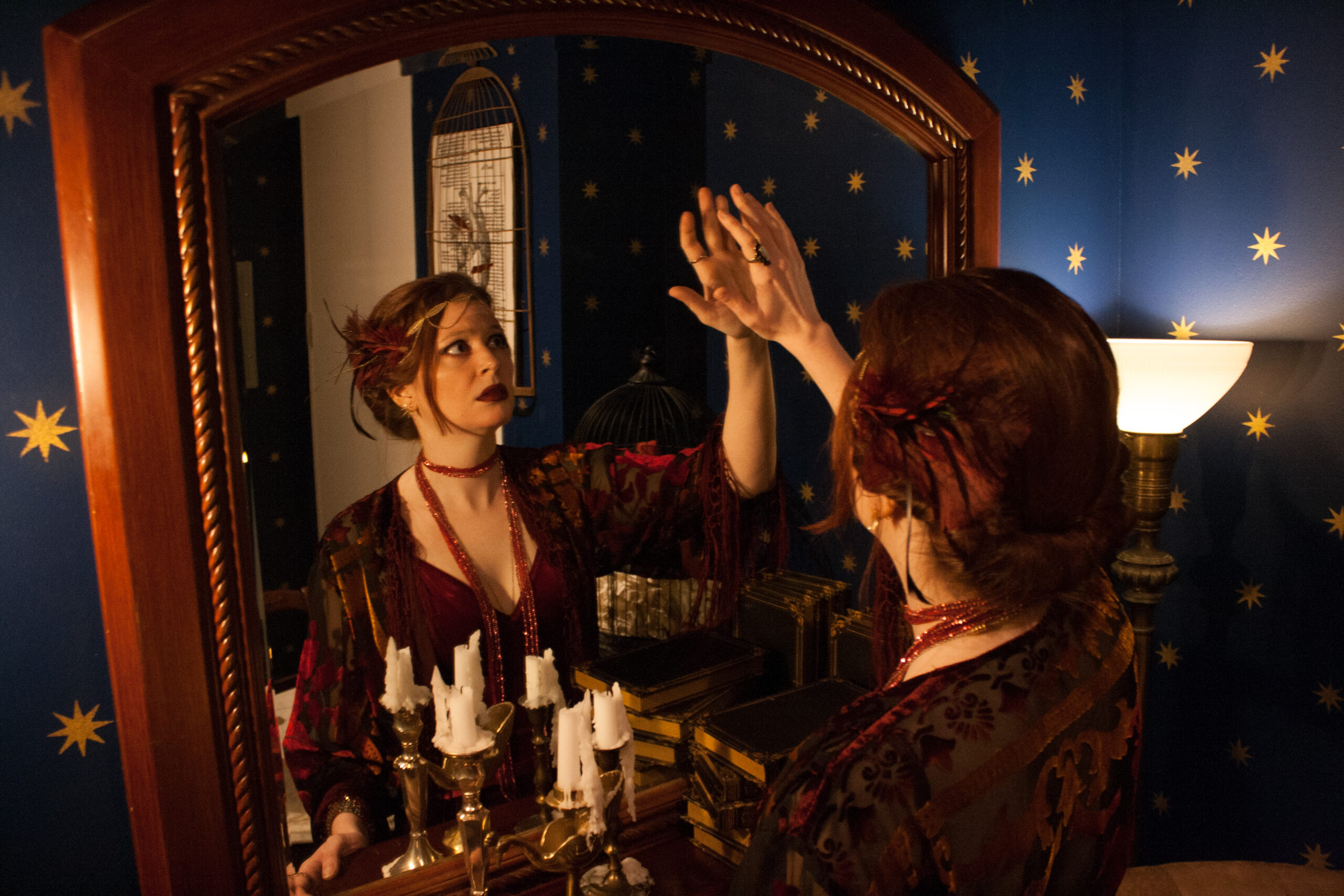
It was Saturday afternoon, and I was soldering twenty $5 flashlights into something equivalent to $300 focusable DMX controlled spotlights, as you do, listening to my favorite niche podcast, as you do. And that was where I was when I learned about the twentieth-century German Marxist-existentialist philosopher Ernst Bloch.
Stay with me.
I had to put my soldering iron down. I was crying. I knew then why I make escape rooms.

Bloch 101
Ernst Bloch posits that the existential crisis emerges not from a deficit of meaning, but from a surfeit of hope. People always imagine their futures richer—richer in love, learning, friendship, money, etc., living in a world bending more to justice, peace, democracy, etc. When high hopes meet harsh reality, crisis occurs.
As I’ve devoted the better part of ten years to making one particular escape room, this rang me like a bell. I am hope incarnate. I eat hope for breakfast. There’s also a fair amount of existential crisis in my life: Lucidity still isn’t open.

But it was Bloch’s theory of aesthetics that had me in tears: that every work of art is a concrete utopia. An expression of the Not Yet, a way the world could be. Art is an act of hope. Music has an addictive, sacred sense to it, because we yearn for resolution that the song inevitably delivers. It instills hope in us via the musical structure, and then it fulfills that hope.

Escape Rooms as Utopias
Ernst Bloch didn’t live long enough to analyze escape rooms, but I suspect he would conclude that an escape room is a radical act of hope.

The structure of escape rooms tells each and every player, “You can make a difference. Go, be a hero!” And isn’t a hero what we all long to be?
When you act in an escape room, you get rewarded—unlike in this world where actions have murky correlations to rewards. Oh, you found something! Maybe it’s relevant? You hope it’s relevant. Five minutes later, hey, it is! We need that! Resolution achieved. The structure of the game instills hope, and when a team wins, their hope is fulfilled.
This is literally the opposite of an existential crisis.
And then there are the many worlds we create: do they not promise lives of adventure? Excitement around every corner? Where everyone collaborates towards a common goal? Sounds like a utopia to me.
Even horror games. The delicious rush of adrenaline, the chance to feel fear in a safe environment, the promise you can escape the horror. I love that world, too.

I think that has a lot to do with why this format is so popular: we’re all escaping into a world that’s better than the world we’re in.
The Man From Beyond is a world full of hope: that the dead live on, that people can learn from their mistakes, that love is an unbreakable thread. Tell me you don’t want to live in that world.

There is power here we must acknowledge, a responsibility we cannot shirk. And yes, this means that teams should be winning your escape room. Who likes the song that goes unresolved?
I admit, when the existential crisis hits, and waves of unrealized hopes knock me off my feet, I ask, why have I devoted this much time to building Lucidity? Isn’t it a bit…silly?
After all, it’s just an escape room!
Never Say It’s Just an Escape Room
Banish that phrase, “it’s just an escape room” from your lexicon. That’s like saying it’s just a novel, it’s just a piece of sculpture, it’s just a Tony-award winning musical. Nonsense. This is art. This is the stuff that changes lives.
Hope is never a silly thing to devote yourself to. Hope is what keeps us going during dark times, so that brighter days can happen.
I’m not certain the arc of the moral universe bends towards justice. I think it has to be bent, and that requires hope. It requires escape rooms.
So go ahead and spend years and dollars, blood and sweat and tears, dreaming up the world you hope for, tweaking a design choice, iterating on a puzzle, maintaining that world at all hours, attending that international conference—what you’re making makes a difference.
Show us the way the world could be.

Thanks to Philosophize This!, Episode 230. I thought about picking up Bloch’s The Principle of Hope directly, but it’s three volumes, and I clearly have something else I need to do.
Author’s post-script: This piece was originally written for the Reality Escape Convention 2026 newspaper. (They selected my controversial article instead).
So if you are a maker of immersive theatre, or heck, ANY ART AT ALL, please know all of the above applies to you. Do not dismiss what you do, even in your hardest times.
But I suspect you already feel that, in your bones, that your work has this profound purpose. Escape room creators have greater need of this message, as the industry hasn’t really accepted it’s art yet.
Discover more from Immersology
Subscribe to get the latest posts sent to your email.


You must be logged in to post a comment.