Today’s theory I’ve been tossing around in my mind for quite some time. It’s the result of ten years of playing escape rooms and a dozen years of attending immersive theatre.
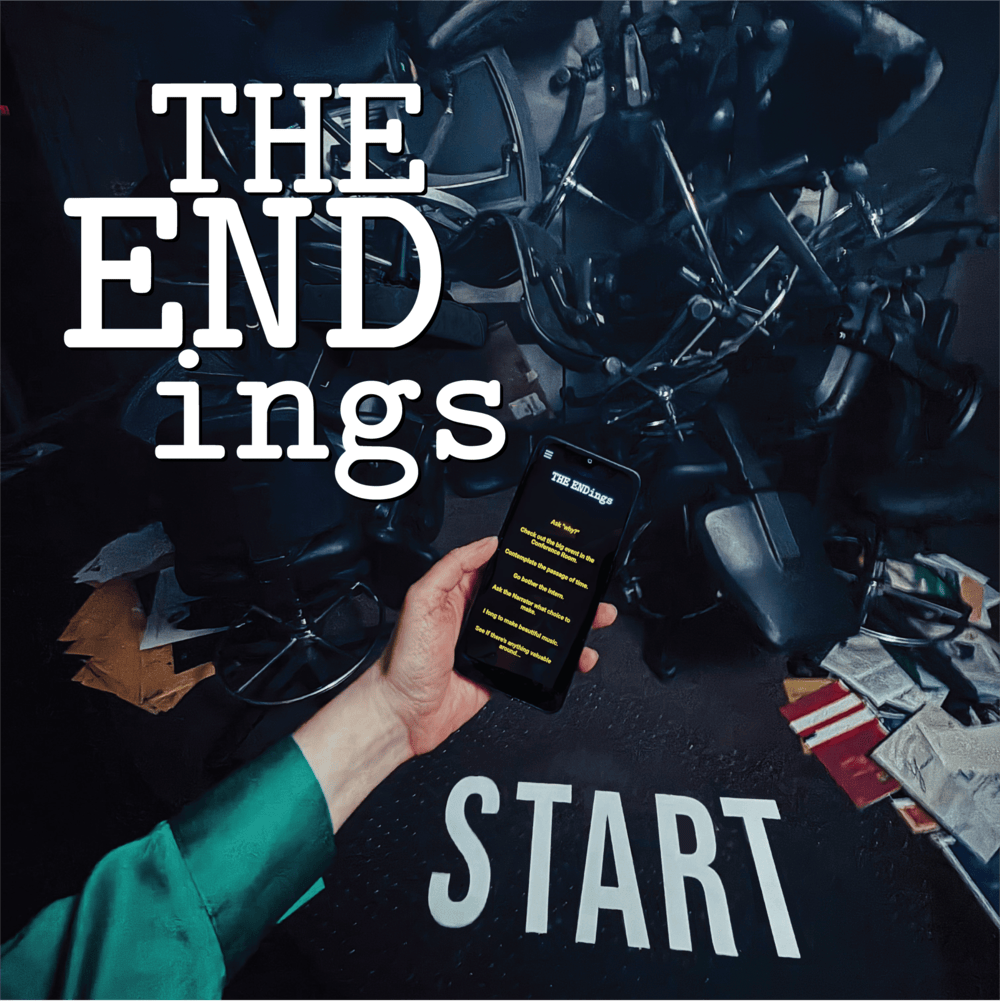
I’ve even put this theory to the test with Strange Bird Immersive’s latest production THE ENDings. (Yes, we really do close July 26. No, you do not want to miss this wildly new immersive structure.)

This theory is ready for prime time.
Be sure to read to the end to get actual returning numbers on Strange Bird productions…
Replayability: The Holy Grail
Whether you’re in it for the money or the audience impact, every business owner would say the holy grail is to get people coming back.
Return business decreases your cost of customer acquisition, increases customer lifetime value. More impact! More money! Yay! But returning doesn’t come naturally to all businesses; in some industries, like ours, you have to decide if you’re designing for return business or not.
Unlike traditional theatre, where you may return to a company, but you’re likely seeing a new production, immersive theatre can aim for return business within the same production. The typical approach is to add more stuff—spaces, content, engagement—than you can see in a single visit. Expensive, but probably less expensive than a whole new production.
Imagine…a single customer buying 11 show tickets, plus 5 party tickets! (That individual was me. RIP McKittrick Hotel).

Escape rooms, on the other hand, face a nearly impossible task in creating return business. The facility may be able to get a customer back, but typically only with a game they haven’t played before, which is expensive. Standard escape rooms are one-and-done; once you’ve solved the puzzles, seen all the surprises, it won’t be the same fun anymore a second time. To target the Holy Grail of Replayability with a single escape room requires intention and innovation. Like Hatch Escape’s The Ladder.
If you want to optimize for replayability, you have to look at what makes the Holy Grail, well, Holy. Why are customers coming to you in the first place?
The Divinity of Discovery
The single most compelling feature of immersives is discovery. When I’m sitting at home on my couch watching another dramatic turn in Severance, I get surprised. But when I’m on my feet, and I get surprised, it turns into “discovery”—embodied surprise. “I discovered this.” Active voice. There’s an ownership to the surprise. If I hadn’t been there, the surprise might still be buried. Discovery is what makes the immersive genre so insanely addictive.

The Discovery Hierarchy
But not all discovery is created equal. Some discoveries are more exciting than others. The Discovery Hierarchy is as follows…
- Space
- Content
- Puzzles and engagements
- Points (aka mastery)
When people talk about cool moments in an immersive or escape room, this hierarchy reflects the intensity of their excitement.
Here’s my theory: to achieve replayability, you must leave some things undiscovered on a first visit. But you will achieve replayability best when you leave undiscovered the most exciting tiers of discoveries.
Breaking it down…
Space
There’s no thrill like discovering new space. Spaces are EXPENSIVE (square footage is the biggest expense in the industry), and, oh boy, people love seeing money spent. Space is a big visual statement, and people remember big visual statements. New space has set dressing and props that expand the story’s world, lots of new details to take in. No team experiences a high as great as when they enter a brand new space.

Imagine discussing an immersive show with friends and saying, “WAIT. THERE’S A FIFTH FLOOR???” (Let us not speak of the SIXTH floor.)
You’d want to go back, wouldn’t you?
The more spaces you leave unseen, the better. One room won’t have as much of a draw as say, three.
Note that you don’t have to have a lot of square feet to make space a key draw, if your experience employs a structure that gates spaces from guests. Then She Fell from Third Rail Projects did a phenomenal job of creating many small rooms out of 4,000 sqft, not all of which you would see on a given track. After my first visit, I was never led into Lewis Carroll’s boat room. You bet I went back.
Content
Players also buzz about what happened to them. The story: what they found in the locked tomb, the people they helped along the way, the way the world changed. “This character poisoned that character! I saw it!” “Wait, what??” your friend says. Now they want to go back.

Note that they’ll buzz only about big content. Major plot points, high stakes, “need to know” stuff, revelations that make sense out of what is happening. “Nice to know” content (lore and facts irrelevant to the plot) are a lesser form of content here, and so unreliable as a pull to replayability. And boring the first time, frankly.
Doors of Divergence famously brought players back by aiming at undiscovered content. The spaces mostly stayed the same, but the narrative changed completely.

And that was absolutely worth another ticket. (Get hype: Doors is coming back!)
Special effects and set scenes also fall under the category of content. One-on-ones, magic tricks, staircases that reveal themselves, blood rave prophesies with insane strobes, all the things that thrill people—miss these, and you’ll want to come back.
Puzzle and Engagements
Next on the hierarchy is puzzles and engagements. Let’s say I’ve seen all the rooms in the experience, and the story/scenes/special effects won’t change, BUT! There were some puzzles I didn’t get to play. Am I buying another ticket?
For some enthusiasts, absolutely yes. I’d argue you’d need to cross a threshold of missed puzzles, something like 40% missed, combined with an excellent experience overall, to bring them back. One puzzle off in the corner isn’t quite enough to justify a new play-through.

But does the general public get pulled back in when puzzles are left unplayed? Probably not as much. The result of the story is the same: someone solved it, so our adventure continued. You have to be a real puzzle hound to need to solve every puzzle. (And, well, Los Angeles is full of puzzle hounds. Hatch Escapes knows their market. Consider yours when designing).
Same thing with any interaction or engagement. In an immersive theatre piece, when you get a closed-door one-on-one you’ve never had before, the thrill comes from 1) new space (where applicable) and 2) new content. Rumors of these compel me to go back. But a public engagement that I didn’t get selected for? Say, like a character asking an audience member a profound question, or doing a magic rope trick together? I’m not buying a ticket just to try to score those. They may not have been with me, but there’s no big discovery there.
Points (aka Mastery)
Finally we come to points, achieving mastery inside a space. I suppose it counts as a kind of discovery, call it self-discovery of just how good you can be. Can you get a higher score than your previous best? Can you get the highest score of the month?

Again, there are some types that find the call to mastery compelling. But the general public, they are not.
Video games gave up using points to compel replayability a long time ago. Now they invest in larger worlds and flexible stories.
Case Study: THE ENDings
In October 2024, Strange Bird Immersive debuted a new genre of immersive with THE ENDings. Given a flashlight and headset and an impish narrator for company, each player explores an abandoned office suite, finding locations, doing unusual things, and making choices along the way that shape how the story ends.

We designed THE ENDings for replayability by gating the discovery of certain rooms and creating lots and lots of content (tiers 1 and 2).
There’s 4,600 square feet to explore in THE ENDings. It’s a big space. But you could walk it all in five minutes. Instead of free exploration, we gate the space by only allowing you to enter a room if the story you are on instructs you to enter that room. We boxed off sightlines and blocked off windows, so you can’t sneak a peek into the Boss’s Office until the Narrator gives you permission.
When writing the stories, I kept track of how often a story used a room and kept multiple rooms as one-story-only spaces, with a few more as two-story-only spaces, in order to encourage the desire to return. The result? I’ve heard players tell me (both when I’m in character for THE ENDings and out) that “I want to see The Woods.” “Please can I see the Party Room?” “What’s in that closet?”

The rooms are of course devilishly labeled to tempt you.
As to content, the model is inspired by Choose-Your-Own-Adventure novels, so there’s a LOT of content. THE ENDings features 11 different stories and 35 different endings. Most players collect four to five endings per visit. So you get one-seventh the possibilities per visit.
I’m a big fan of experience maps, and I haven’t bothered to map this show, it’s just too much.
The result? We’ve seen people come back three, four, even five times. They need to know what else is happening in this surreal office. They want more stories. They crave the DRAMA.
We started seeing enough returning players, in fact, that we wrote new scenes for the actor one-on-ones, in order to address the reality that this player was returning (the original scenes make little sense if the player has been before). And of course, the player gets a huge bonus: new scenes to buzz about!

But let’s not talk impressions. Let’s talk numbers.
10% of guests who attend THE ENDings return to play it again. That’s…wow. Really high. Even I was surprised when I ran the numbers. Add the fact that over 30% of THE ENDings guests are out-of-towners, making a return visit much harder, and that number is even more impressive.
And as theorized, undiscovered spaces draw people to return more than undiscovered content. There’s more of a drop-off in the returnee pool after the second visit, and seeing every space can usually be done with a second well-planned visit. Perhaps if the content weren’t structurally independent of each other, like short stories, but deeply intertwined, like a novel, content would be a bigger draw. But there are still some content super-fans out there. I regret I cannot ask our actors for a fourth set of one-on-ones just for the super-fans (so we give them a surprise gift the fourth time instead).
Another reason to go back?
The discovery hierarchy does not cover every reason to return. There is another, perhaps most compelling reason to repeat an experience: because you loved the way it made you feel.
People chase after that feeling again anytime they rewatch a movie or tv show, reread a book, or replay a video game. They love the jokes, the journey, the characters, the world, the emotional ride, they make something of a home in it.
I’ve long believed that The Man From Beyond gets return business because people love the feelings it gives them, start to end. There are no spaces left to discover, no new content to discover (save a single one-on-one you still may not get your second time), and depending on how you played, you’ve missed probably only 3-4 puzzles.
Yet people come back, because we take them on a journey.

It’s a feeling worth returning to.
Over 2% of players replay The Man From Beyond. For a game that does not aim at replayability, that’s a lot of returning players.
While it may not draw as many people to return as missing out on The Party Room, investing in delivering an emotional journey will leave an impact on all players, returning or not, causing that word-of-mouth buzz that keeps a business busy.
Let’s test it!
I’d love to test this theory further. Have you designed an experience for replayability? Which discovery tier did you emphasize? What are your returning numbers like? Reach out to me!
I think we can all lean into discovery more. That’s what this is all about. And if we lean into discovery in targeted ways, we might just capture that holy grail of replayability.
Discover more from Immersology
Subscribe to get the latest posts sent to your email.


You must be logged in to post a comment.